Fake Tan Chong Koay ads: Pheim’s warning and next steps


Checked by The Proofmark editorial team against our methodology before publishing
The Proofmark · Our methodology
Is that investment ad really from Tan Chong Koay?
Pheim has disowned the Facebook and Instagram promotions described here. They use the name or image of Dr Tan Chong Koay, Pheim Singapore's founder, to make an investment approach look familiar and credible. This is a report about impersonators, not an allegation that Pheim or Tan created their offers.
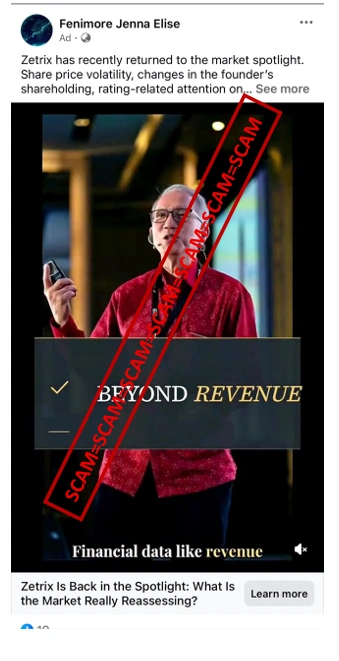
Pheim's warning about a Facebook advertisement, identified on 5 October 2026 and published on 7 October, describes an AI-manipulated video that falsely links Tan to an opportunity involving Zetrix. It names the pages Fenimore Jenna Elise and Ethan Palmer Mohammed K Ahmadi. The mention of Zetrix is part of the disputed advertisement; it does not establish that Zetrix made or authorised it.
The original example above comes from Pheim's warning. Pheim added the red “SCAM” marking. It is not an image we generated or an independent forensic test of the video.
The second warning shows where the conversation can lead
A further Pheim notice concerns an Instagram advertisement identified on 12 October, with the notice published on 13 October. It led to a WhatsApp contact using Tan's name to offer stock ideas and investment advice. Pheim says the contact was unauthorised.
The two notices document impersonation across different channels. They do not establish a common operator behind every account. A page disappearing or changing its name also makes a search for the old account an unreliable safety check.
Our review on 26 October uses those saved official examples. It does not claim that the same ads are still running today or that they were shown in every reader's country.
How to check an offer before you send money
A convincing face, voice or account name is not enough to identify the person behind a message. A video can be altered; genuine clips can also be reused beside a false offer. A smooth-looking video is therefore no safer than an obviously awkward one.
Start outside the advertisement. Find Pheim's contact details on pheim.com.sg, then ask whether the exact account, website and proposed payment recipient belong to it. Do not use a “verification” number supplied by the person selling the investment.
Before considering any offer, identify three separate things: the legal business providing it, the website you would use and the person or company receiving your payment. A real company's registration cannot authenticate an unrelated WhatsApp account. Our guide to investment chat groups explains the checks in more detail.
Already contacted the account or sent money?
If you paid, contact your bank or the exchange you used promptly. Say you suspect an investment impersonation scam. Give the recipient, amount, date and transaction reference, and ask what action is possible. Keep the case number. A bank or exchange cannot guarantee recovery, but delay can reduce the options.
Then act according to what you shared:
- Only messages or contact details: save the conversation and account link before blocking it. Expect follow-up calls that use what you already told the first contact.
- A password or login code: secure the affected account through its genuine website or app. Change reused passwords and review active sessions.
- ID documents or remote access: tell the relevant provider what was exposed. Remove unknown access with trusted technical help, preferably using a separate safe device to secure financial accounts.
- A payment: keep the original ad, chat export, receipts and any promised return or withdrawal conditions. Report the impersonating account to the platform and suspected fraud to the authorities where you live.
Our reporting guide helps you prepare a useful report. Do not pay a new “tax”, account-release charge or recovery agent simply because they promise to solve the first problem.
Talk through what happened
If you contacted someone claiming to be Tan Chong Koay or Pheim and lost money, our free phone consultation can help you understand what to do next. Tell us how the contact began, where you sent the money and what they are asking for now. We will help you sort the facts and identify the next steps for your situation.
Request a free call. You do not need to understand the whole scheme before asking for help.
Sources
Where to get help in your country
Choose your country to see where to check a company, report a scam and get help.
Choose your country to see local contacts. If it is not listed, you can ask our team for help.
🇬🇧 The United Kingdom
🔎 Check the firm
FCA Firm Checker — Search the firm name, its website, or the reference number it gave you.
🚨 Report it
Report Fraud (City of London Police) — Report online or call 0300 123 2040. In Scotland, call Police Scotland on 101.
↩ Ask for your money back
Financial Ombudsman Service — Complain to the firm first. If the issue remains unresolved, check whether the Financial Ombudsman Service can handle your case. Its service is free.
Contacts and responsibilities can change. Check the details on the relevant official website.
Was this article helpful?
Thank you. Your feedback helps us improve.
Your reason has been saved.
Your callback request is received.
Our team will call .
You do not need to send another request. The call is free.
Your reference:
Request a free callback
Leave your number. We will talk through what happened.
Name and phone number are required. All other details are optional.
Your saved draft has been restored.