Max Vault Forensics: Facebook money recovery offer checked


Checked by The Proofmark editorial team against our methodology before publishing
The Proofmark · Our methodology
What the Facebook ad promises
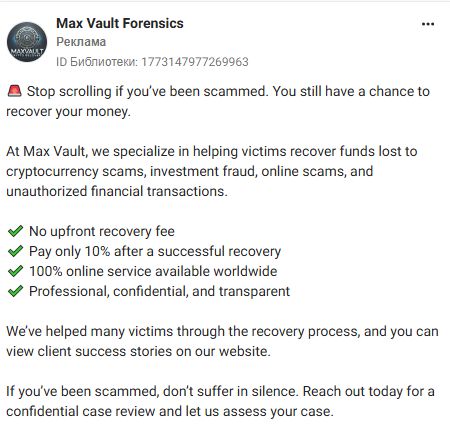
The Max Vault Forensics advert addresses people who have lost money through crypto scams, investment fraud and other online scams. It presents a reassuring payment model: no recovery fee in advance, followed by a 10% fee after a successful recovery. It also describes the service as online and available worldwide.
Meta Ad Library showed the creative as active on 6 November 2026, with a start date of 14 October 2026. The visible button invites the reader to send a message. The advertiser’s Facebook page separately links to www.maxvaultcyberforensic.com. That distinction matters: this was a route through the page, not a verified direct website link in the ad button.
These are the advertiser’s claims. An active ad is evidence of promotion, not proof that money has been recovered. The library’s country filter does not establish who actually saw the campaign.

Original video preview from Meta, captured 6 November 2026. This image identifies the creative; it does not verify any testimonial or recovery.
Why the linked website needs attention
On 6 November, the linked website was unavailable. Its public domain record showed client hold: a registrar-set status that prevents the domain from resolving normally. The record dates its registration to 4 September 2026.
The status explains a technical obstacle to opening the site; it does not disclose why the registrar imposed it. It is not, on its own, a finding of fraud or proof that the business has permanently closed.
The practical problem for a prospective client is more immediate. The ad directs people to a conversation while the linked site is not providing a place to check the operator and terms. Before sharing documents or committing to a service, obtain the legal name, address, written scope and full fee conditions, then verify them independently. The Facebook name and a testimonial are not a substitute for those details.
What must “10% after success” mean in writing?
The key issue is the event that triggers payment. Is the fee due after money actually reaches an account you control, or after the provider merely says it has located funds? Those are very different outcomes.
For example, 10% of 2,000 actually returned would be 200. A screenshot claiming that 20,000 has been “found” does not show that any money has been returned, and should not by itself trigger a fee. This is an illustration of the contract question, not a reported Max Vault customer case.
Ask for written answers to four points:
- Which legal entity provides the work, and who receives any payment?
- What exactly will it do: trace transactions, prepare a report, contact a bank, or arrange legal representation?
- Is success defined as funds actually received by you? Are taxes, network charges or other costs excluded from the advertised fee?
- What happens if no money is returned, and how can you end the agreement?
Tracing a cryptocurrency transaction can help document a case. It is not the same as controlling the receiving wallet or having authority to compel repayment. A provider should explain the specific process, not simply show a large balance and ask you to unlock it.
If you have already contacted the advertiser
Save the advert, Facebook page, messages and any agreement before they change. Keep the original loss separate from any new recovery-service payment. Record each recipient, date, amount and payment method so your bank can understand which transaction you are reporting.
If you suspect deception or have already paid a questionable demand, contact your bank or payment provider promptly. Ask about the options and deadlines for that payment. For crypto transfers, alert the exchange you used and supply the transaction identifier. Report suspected fraud to the relevant authorities in your country.
Do not share wallet recovery words, passwords or one-time codes. If you have given someone account access or installed remote-control software at their request, disconnect that access and seek help securing the accounts from a trusted device. Do not make another transfer merely because someone promises it will release recovered money.
Our assessment of this offer
The combination of an active recovery advert, an unavailable linked website and success claims without supporting payment evidence warrants caution. The reviewed material does not establish a proven fraud, independently verified recoveries or an identified legal operator. “No upfront recovery fee” is one contract term, not a guarantee of safety.
Our guide to checking recovery services explains how to assess a proposed agreement before paying. If new evidence identifies the operator, clarifies the terms or documents an actual outcome, it should be assessed alongside this dated ad check.
Need help with a specific offer or payment? In a free phone consultation, we can help you separate the original loss from the new proposal, organise the records and understand what to ask your payment provider. Discuss your situation. We do not promise a recovery.
Sources and evidence
- Original Meta advert 1773147977269963 and advertiser page 61573322622466, observed 6 November 2026. The original preview, text and page-to-domain link are retained in our evidence record. A preview is not proof of the claimed results.
- Public domain record for maxvaultcyberforensic.com, checked 6 November 2026.
- ICANN: meaning of client hold.
- FTC: refund and recovery scams. General consumer guidance, not a finding about this advertiser.
Where to get help in your country
Choose your country to see where to check a company, report a scam and get help.
Choose your country to see local contacts. If it is not listed, you can ask our team for help.
🇬🇧 The United Kingdom
🔎 Check the firm
FCA Firm Checker — Search the firm name, its website, or the reference number it gave you.
🚨 Report it
Report Fraud (City of London Police) — Report online or call 0300 123 2040. In Scotland, call Police Scotland on 101.
↩ Ask for your money back
Financial Ombudsman Service — Complain to the firm first. If the issue remains unresolved, check whether the Financial Ombudsman Service can handle your case. Its service is free.
Contacts and responsibilities can change. Check the details on the relevant official website.
Was this article helpful?
Thank you. Your feedback helps us improve.
Your reason has been saved.
Request received
We’ll call you soon.
Your reference:
Request a free callback
Leave your number. We will talk through what happened.
Name, phone number and consent to a callback are required.
Your saved draft has been restored.